


Longevity clinic software questions, answered (2026)

These are the questions clinic owners ask us most, with short answers. Each section points to a longer page. For the product itself, see Neogenic for longevity clinics.
How we answered
Answers about Neogenic come from the live neogenic.ai pages. Facts about other vendors come from their own websites, read on 26 October 2026, each with a source number.
The basics
What is longevity clinic software?
It is the software a proactive-health clinic runs on. It usually covers enquiries, booking, programmes and memberships, follow-up, billing and a patient portal, in one place.
How is it different from a general EHR?
An EHR is built around the clinical record and, in the US, insurance claims. Longevity clinics mostly sell programmes and memberships that patients pay for themselves, so billing, follow-up and the patient relationship matter as much as the chart.
What does agentic-first mean?
It means an AI agent does work inside the software, not only answers questions. In Neogenic, Neo does admin work for your team, within each person's permissions, and waits for approval before changes that are hard to undo.
Who is Neogenic for?
Longevity clinics, aesthetic clinics and medspas, diagnostic and screening centres, biohacking and recovery centres, and labs.
Neo, the AI agent
What can Neo do?
Neo works with contacts, companies, opportunities, tasks, deal notes and emails, within each person's permissions. It books, reschedules or cancels clinic appointments, drafts emails and documents for your team to review, and answers questions about your clinic's bookings, contacts and tasks.
Does Neo need approval for changes?
Yes, for changes that are hard to undo, such as deleting, archiving or publishing. Neo shows an approval card first. Routine updates run directly.
Does Neo interpret lab results?
No. Neo does not diagnose, suggest treatments or interpret results. Clinical decisions stay with your clinicians.
Is our data used to train AI models?
No. When Neo is switched on, it runs on Amazon Bedrock in the EU. Bedrock writes no prompt or response to lasting storage, apart from one narrow exception described on our subprocessor list, and keeps only a short-lived cache to answer faster. The model's maker never receives them, and they are never used to train models.
See what Neo does for examples.
Prices
What does Neogenic cost?
Exploration is €270 ($299) per person per month, for up to 4 people. ClinicOS starts at €1,320 ($1,499) per location per month with 6 staff accounts. The Patient Portal and patient AI agent are an optional add-on at €270 ($299) per clinic location per month, with 100 active Portal patients included. A one-time setup fee of €900 ($990) is free on the yearly plan. Prices exclude VAT.
Why do vendors price so differently?
They charge by different units. Some charge per user or practitioner, some per plan with a client limit, some per location, and some only by quote. Price your own team and patient numbers at each one.
Published starting points differ by unit. Healthie starts at $18 per month billed yearly for 10 active clients[1], OptiMantra at $99 per month for the first practitioner[2], Pabau at $104 per month for one user[3], and Reya.ai Essentials at $850 per month.[4] Semble and LongevAI share prices in a demo.[5][6] Our pricing guide works through one clinic at several vendors.
Data and hosting
Where is Neogenic data stored?
In the EU. Databases and files are in Stockholm and the application runs in Frankfurt. Neo runs on Amazon Bedrock in the EU.
Is any data processed outside the EU?
A few supporting services, such as email delivery, use providers outside the EU. Where a provider can access data from outside the EU, the EU Standard Contractual Clauses protect it.
What should we ask a vendor about hosting?
Ask where clinic data is stored, where the AI runs, whether there is a Data Processing Agreement, and for the current subprocessor list.
Vendors answer the hosting question differently. Healthie says it stores data in the United States[7], and a Cerbo article says its data is in US data centres.[8] Pabau names London, with Singapore and US regions on request.[9] Semble says it uses UK and EU data centres.[10] Read our guide to EU-hosted longevity clinic software and the Neogenic GDPR page.
Patients
Is there a patient portal?
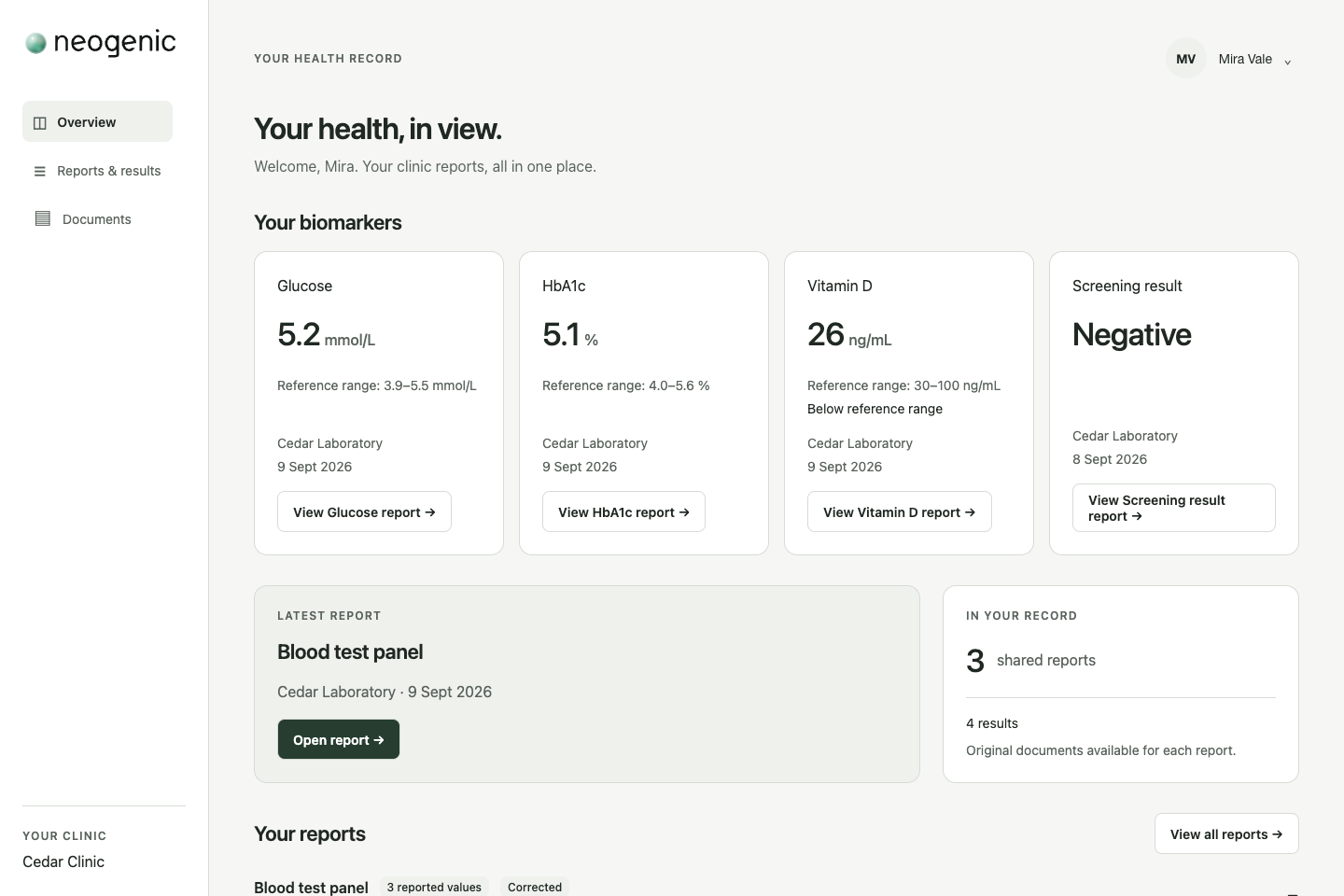
Yes. The Patient Portal runs on the web, with iOS and Android coming soon. Patients follow their results and plan, book appointments, message your team and pay.
Can patients pay for programmes in instalments?
Yes. In Neogenic a deposit can secure a programme and is applied to the final invoice, and instalments spread a larger programme across agreed dates.
Choosing software
What should we ask every vendor?
Ask where clinic data and AI processing run, what the AI may change on its own, how programmes and memberships are billed, how you export your data if you leave, and what the full monthly cost is for your team.
Where do we start comparing?
Start with a list of the work your team does every week, then see which tool covers it with the fewest add-ons.
Start with the best longevity clinic software platforms, see Neogenic compared with other tools, or browse alternatives to the tools you use now.
The Neogenic team wrote this guide. Read more about Neogenic.
Facts about other vendors were checked on their own websites on 26 October 2026.